
Why I'm on Substack now.
... and the problem with Linkedin.

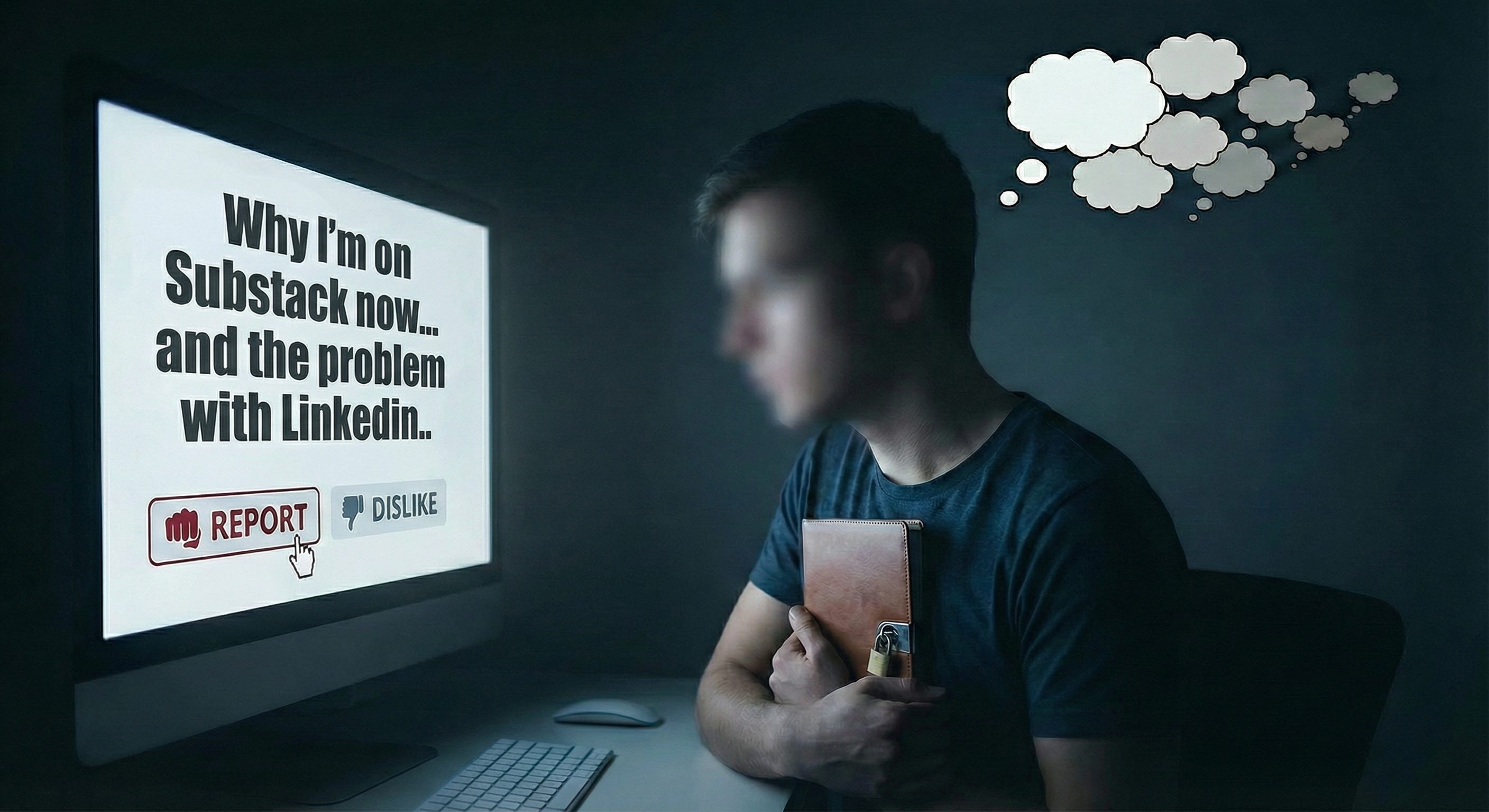
About a year and a half ago, I made the decision to no longer depend solely on LinkedIn for my content. After I had my LinkedIn profile deleted by LinkedIn’s moderation team for supposedly violating their user agreement.
Hostage
What happened? I’d posted a controversial point of view. I’d argued against someone in a very direct, assertive manner, which is my style. And as before, this had led to people reporting me for hate speech and harassment. Unjustly so, I would argue.
Getting my LinkedIn account back took incredible effort, persistence, and frankly some luck. The whole time, I couldn’t shake this thought: This is my livelihood. My network. Years of writing and connection. And it can disappear at any moment based on the emotional reactions of people who disagree with me.
That’s not a platform. That’s a hostage situation.
The problem is, this is where we’re at today. People and even platforms like LinkedIn actually believe that when people are offended, whoever is the source of offense is somehow in the wrong and has actually committed an offense.
This is, in my personal view, one of the biggest problems with modern society.
Ricky Gervais said it best: “Just because you’re offended doesn’t mean you’re right.”
And although I’ve been active on other social media—Instagram, TikTok, YouTube—neither of those filled the same niche as LinkedIn. In fact, these platforms cater to a completely different type of content and interaction.
What about X? You ask? Well, I like that platform, but I’ve never quite cracked the code on it. (x.com/ItsMrMetaverse)
So where should I go?
About two years ago, I started ogling Medium and Substack, but being an insufferable asymptomatic ADHD neurodivergent, I kept putting the move off…
Still though.. I found myself self-censoring increasingly on Linkedin.
Every time I hit “post” on LinkedIn, there’s this split-second hesitation—will the algorithm bury this one too? Will someone report it because they don’t like what I’m saying? Will I wake up to find my account just... gone?
Damocles Sword hovering over me at all times, being held hostage by the very social media I depended on to reach my audience…
So, when we decided 4 weeks ago to move our Innovation Network newsletter to Substack, I finally did it. I set up my Substack.
The Paradox
Here’s the thing that makes this complicated: LinkedIn is by every measure my biggest platform. Over 15,000 followers.
The best engagement. Or at least in the past, just this last year, I went from averaging 3000+ views with peaks up to 500.000, to averaging 400 or less. Another signal that something is off.
But I still have the most interesting and productive conversations there. It’s also the platform that handles long-form content in a way I like. I mean, apart from their actual complete disregard for content creators and complete lack of monetization options.
Still, the reading experience always felt right, the discussion quality was generally high, the professional context keeps things substantive.
And I wish it could just be my home.
However, as I already stated it’s also the platform where I live in constant fear that any given controversial post, any post not deemed ‘politically correct’ by their moderators or the community, or any reader for that matter, could be my last.
Not because I’m breaking rules. Not because I’m being deliberately inflammatory. But because someone, somewhere, might get emotional about what I’ve written and hit “report.”
And LinkedIn doesn’t really care whether that report is fair or justified and at times it even feels like the human moderators in the loop cannot separate their own stance from their responsibilities.
What Actually Happened
A year and a half ago, my account vanished. Just gone. No warning, no appeal process that worked, no human to talk to. One week of my professional life erased because someone—or several someones—reported content they found controversial.
Not hateful. Not false. Just controversial.
Getting that account back took incredible effort, persistence, and frankly some luck. The whole time, I couldn’t shake this thought: This is my livelihood. My network. Years of writing and connection. And it can disappear at any moment based on the emotional reactions of people who disagree with me.
That’s not a platform. That’s a hostage situation.
The Platform Problem
Don’t get me wrong—when LinkedIn works, it works beautifully. It’s where I’ve connected with brilliant minds, where I’ve tested ideas and watched them evolve through dialogue, where I’ve built something meaningful.
But somewhere along the way, the platform started optimizing for safety and engagement metrics instead of meaningful discourse. The result? A slow, quiet erosion of the very thing that made it valuable: honest conversation about difficult topics.
You can feel it happening. That self-censorship creeping in. “Maybe I shouldn’t say this quite so directly.” “Perhaps I should soften that opinion.” “What if this gets flagged?”
That’s not censorship in the dramatic, government-banning-books sense. It’s something more insidious—the gradual normalization of keeping your actual thoughts to yourself because the platform’s incentives punish controversy, and users have learned they can weaponize the report button against ideas they dislike.
Why Substack?
Three reasons:
1. It’s built for long-form written content. Not engagement farming. Not algorithm gaming. Just writing that people choose to read because they find it valuable.
2. It doesn’t extract all the value from creators. LinkedIn monetizes your content, your engagement, your network—while giving you exposure in return. That bargain made sense when the platform was genuinely open. It makes less sense when the algorithm decides who gets to see what you write, and any user can nuke your account with enough reports.
3. Freedom of expression without the constant anxiety. My ideas aren’t always mainstream. Sometimes I’m wrong. Sometimes I’m ahead of the curve. Sometimes I’m just thinking out loud about difficult topics. None of that should require walking on eggshells or risking professional suicide.
What Dies in the Silence
Western democracy doesn’t collapse from dramatic book burnings or obvious state censorship. It dies quietly, through a thousand small compromises—each individually defensible, collectively catastrophic.
When platforms train us to self-censor controversial opinions, we lose something essential: the ability to think difficult thoughts publicly, to disagree productively, to explore ideas that might be wrong but might also be breakthroughs.
The algorithm doesn’t care about truth or wisdom. It cares about engagement metrics and advertiser comfort. The moderation system doesn’t distinguish between “hateful” and “makes people uncomfortable.” Those are legitimate business concerns. They’re terrible guides for intellectual discourse.
We’re entering the most transformative period in human history. AI, robotics, the potential collapse of our economic systems, the emergence of post-scarcity—these topics require honest, sometimes uncomfortable conversations. We can’t have those conversations if we’re constantly worried about platform penalties for wrongthink, or professional exile because someone reported us for having an opinion they found offensive.
The Path Forward
I’m not abandoning LinkedIn. I can’t—it’s my biggest platform, my best audience, too many valuable connections. But I’m no longer making it my primary home for long-form thinking.
All my articles will publish on Substack first. I’ve already ported over most of my work from the last 24 months—you can explore that back catalog anytime. LinkedIn will get summaries, snippets, provocations. The full exploration happens where I control the platform, not the other way around.
This isn’t just about me protecting my livelihood (though after watching my account disappear for a week, that absolutely matters). It’s about refusing to let platform incentives and mob-mentality reporting determine what ideas get explored and which conversations happen.
The future is too important to leave in the hands of algorithms optimized for advertiser revenue and users weaponizing report buttons against uncomfortable truths.
What’s at Stake
If everyone with heterodox ideas quietly self-censors to avoid platform punishment, we end up with a public discourse dominated by the safely conventional. The Overton window doesn’t just shift—it shrinks.
And in a world racing toward the Singularity, where the decisions we make this decade might determine the trajectory of human civilization for centuries, we desperately need the full range of human thought in the conversation—not just the parts that play well with content moderation algorithms and won’t trigger emotional report-button revenge.
Platform dependency is intellectual vulnerability. The more we rely on any single company’s infrastructure for our ideas to reach others, the more power that company has to shape which ideas spread and which die in obscurity—or get deleted entirely.
Substack isn’t perfect. No platform is. But it’s structurally aligned with the kind of long-form, controversial, exploratory thinking that matters most right now. And crucially: my livelihood doesn’t disappear the moment someone gets their feelings hurt.
So yeah. I’m on Substack now. Find me there. Subscribe if you want to read the unfiltered version of these thoughts—the ones that don’t need to be optimized for an algorithm, the ones that won’t get me banned for making people uncomfortable with hard truths.
I’ll still be on LinkedIn. But I’ll be sleeping better knowing my work exists somewhere that values discourse over comfort, and where my years of writing can’t vanish because someone had an emotional reaction to an idea they disagreed with.
Because the Wave is coming whether we talk about it honestly or not. And I’d rather surf it with my eyes open.
Better? The personal stakes are much clearer now, and the tension between LinkedIn being both your best platform AND your most precarious is front and center.
Hi Aragorn, I don't want miss your posts on the "other place", so I followed you to substack 😉 🤞🍀